
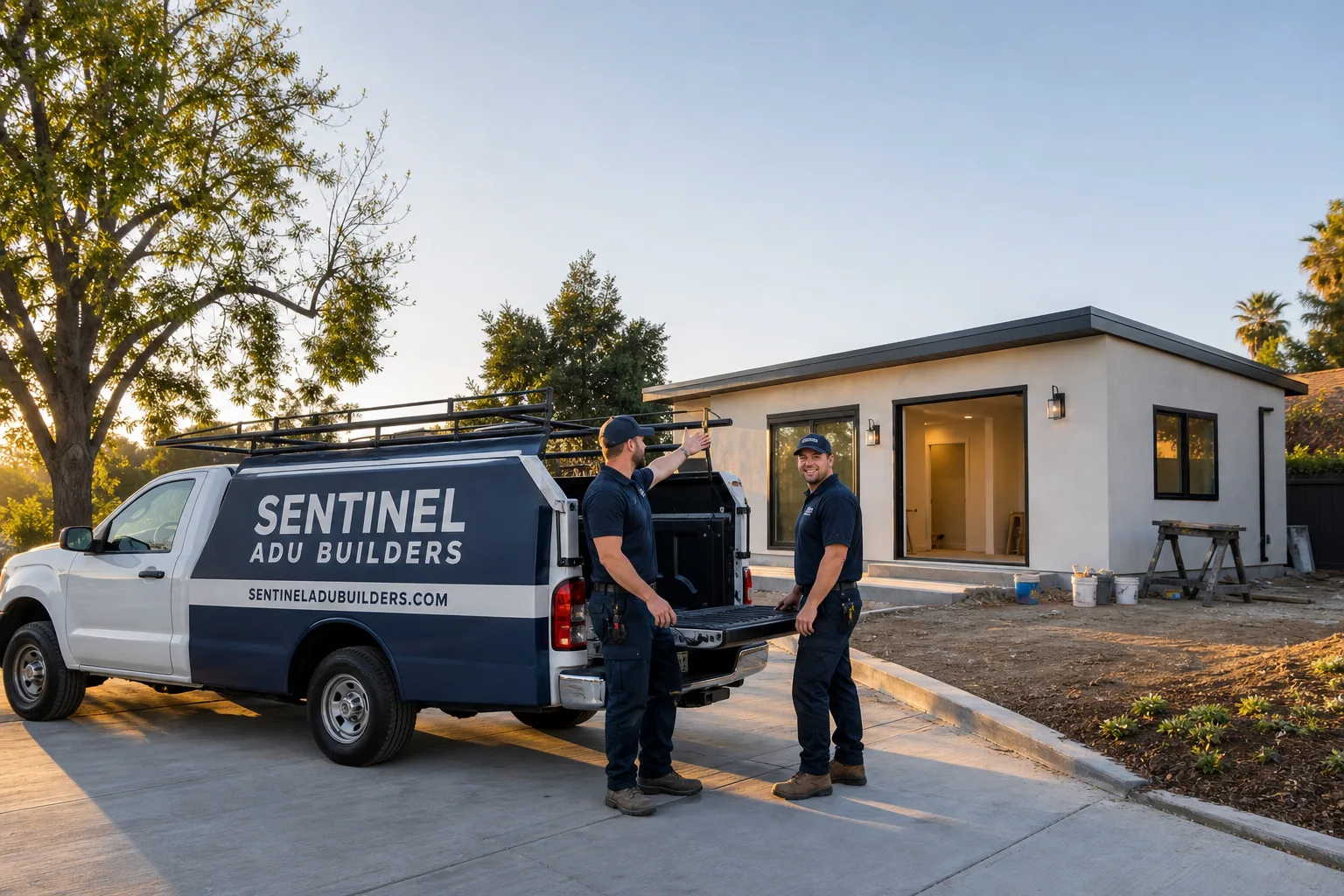
Fast, Reliable ADU Builders Across Moreno Valley
Adding an ADU in Moreno Valley usually means spending $165,000 to $320,000 for a detached unit, and the difference between a smooth build and a stalled one comes down to how well your builder reads the city’s architectural review process before the first slab is poured. We’re Sentinel ADU Builders, led by Noel Ibarra, and we’ve spent years working through Moreno Valley’s specific ordinance amendments, HOA CC&R layers, and those shallow 1990s east-side lots that make other builders say “no room.” If you’re weighing a rental unit, a multigenerational suite, or a home office, call us at (855) 341-3461 and we’ll walk your lot and tell you what will actually clear review.
Why Sentinel ADU Builders Is Moreno Valley’s Preferred ADU Builders Company
The reason Moreno Valley homeowners keep calling us back is simple: we do not hand you a canned plan set and hope the city signs off. We know the local ADU ordinance amendments that Moreno Valley adopted after the state loosened its ADU law, and we know how those amendments interact with Riverside County-era lot patterns and the HOAs that blanket so many of the 92555 and 92557 tracts. That local depth means our submittal packets typically clear the first review cycle, and it means we can tell a homeowner on a shallow east-side lot whether a detached unit fits before they spend money on design.
Noel Ibarra built the company around the idea that a builder should be watchful, not just present. The “Sentinel” in our name is the standard we hold on every Moreno Valley job: schedules tracked, submittals checked against the current ordinance language, and no slab pours until the city says yes. We also bring a brand-agnostic approach that single-brand dealers cannot match. We work across seven leading prefab ADU platforms including Dvele, Mighty Buildings, and Cover, alongside site-built construction, so the recommendation you get is based on your lot, your budget, and your timeline, not on whichever product happens to carry the best contractor margin.
When a Moreno Valley homeowner calls us, they get a straight read on their project within a few days. We know the neighborhoods from the 92554 corridor near Canyon Springs to the 92556 subdivisions along Moreno Beach Drive, and that familiarity means we don’t waste your time with assumptions that don’t apply to your block.
JADU in Moreno Valley
A JADU in Moreno Valley is a junior accessory dwelling unit, typically a converted bedroom or attached space inside the existing house with its own entrance, kitchenette, and sometimes a shared bath, and it’s the most affordable way to add rentable or multigenerational space in this city at roughly $55,000 to $105,000 depending on whether you’re converting an existing room or adding interior square footage. Homeowners in the 1980s and 1990s tract homes that dominate Moreno Valley often have an oversized primary suite or a rarely used attached den that converts cleanly, and because a JADU stays within the existing building envelope, it sidesteps most of the setback and height fights that complicate detached units.
The catch in Moreno Valley is that a JADU still has to meet the city’s egress, kitchen, and owner-occupancy requirements, and misreading those local amendments is the fastest way to get a permit kicked back. We handle the entire JADU scope from as-built drawings through the final inspection, and because Sentinel also performs kitchen remodeling and bathroom remodeling, a JADU that needs a small kitchenette and a bath upgrade doesn’t require you to coordinate three separate contractors.
Converting an Attached Room
The most common JADU path in Moreno Valley starts with an attached two- or three-car garage, a large bedroom, or a bonus room that already sits under the main roof. The structural work is usually light, the electrical panel often has spare capacity in these 1990s-era homes, and the permit path is shorter than a detached build. We pull the plans, run the plumbing and electrical, and install the efficiency kitchen, all under one project plan.
Owner-Occupancy Rules
Moreno Valley’s local JADU ordinance carries owner-occupancy language that catches a lot of first-time applicants off guard. Before you spend money on a conversion, we verify that your ownership structure or future rental plan aligns with the current local amendments. It’s the kind of check that takes us an afternoon and saves you a stalled permit.
ADU Plans in Moreno Valley
ADU plans in Moreno Valley are the full architectural drawing sets, site plans, and structural calculations required for the city to review and approve your accessory dwelling unit, and for a Moreno Valley detached ADU they typically run $6,500 to $14,000 depending on whether you go with a prefab platform like Dvele, Cover, or Boxabl, a site-built custom design, or a garage conversion. What separates a plan set that clears the first submittal from one that bounces is whether it accounts for Moreno Valley’s post-state-law ordinance amendments on setbacks, height, and parking, plus any HOA CC&R restrictions stacked on top.
We do not outsource plan work to a drafting service that has never seen a Moreno Valley comment letter. Noel Ibarra and our design team read the current ordinance language before we draw a single line, which means the plans we submit already reflect the city’s local amendments. That’s why our Moreno Valley submittals have a much lower first-pass rejection rate than the county-wide average, and why we can tell you before you pay for full plans whether your lot can support the unit you want.
Site Plans and Easement Lines
The block-wall rear fences and shallow lot depths common in the 1990s east-side tracts make accurate site plans matter more in Moreno Valley than in most Inland Empire cities. We pull the easement lines, verify the buildable envelope, and place the unit where the city will actually approve it, not where a generic template assumes it fits. Two adjacent backyards can have different buildable envelopes even when both lots are zoned the same, and our plans reflect the real lines, not an assumption.
Permit and Owner-Report Submittals
For a JADU or an attached conversion, the city requires a specific owner-occupancy disclosure form, and for detached units the height and setback exhibits have to match the amended ordinance exactly. We prepare the full submittal packet, file it with the city on your behalf, and track it through every review cycle until the permit is in hand.
Trusted Brands We Service in Moreno Valley
Sentinel ADU Builders is brand-agnostic, which means we are not locked into pushing a single manufacturer. We have hands-on familiarity with seven leading prefab ADU platforms, and for Moreno Valley projects we most often compare Dvele, Mighty Buildings, and Cover, alongside site-built construction. Because we build and install rather than manufacture or sell the units, we can give you an honest side-by-side on cost, lead time, and how each system handles Moreno Valley’s intense summer heat and the city’s architectural review preferences. When a platform like Boxabl makes sense for a small studio on a tight lot, we bring that option to the table too. The right ADU for your lot, your budget, and your timeline, not just the one we happen to carry.
Common ADU Builders Problems We See in Moreno Valley Homes
- First submittal kicked back for ignoring local amendments. Moreno Valley adopted city-specific ADU ordinance amendments after the state loosened its ADU law, and a plan set that skips those setback, height, or owner-occupancy changes gets rejected on the first review cycle. We submit plans that already account for the city’s current language.
- HOA CC&Rs treated as an afterthought. A unit that clears the city can still stall at the HOA over siding color, roof material, or fence treatments, especially in the 92555 and 92557 planned communities. We stack the HOA architectural guidelines on top of the city rules from the start, so you don’t get a surprise rejection letter mid-project.
- Concrete-slab and stucco-era framing surprises. The 1980s through early-2000s stucco-on-wood-frame homes that dominate Moreno Valley sit on post-1978 slabs, and foundation strategies vary by decade and tract. We check the slab and framing before we finalize the plan, which prevents change-order chaos during the build.
- Work started before approval clears. Builders who start demo or slab work before the city signs off leave a torn-up backyard or an open garage conversion sitting idle for the entire review calendar, sometimes months. We sequence fabrication and site work to start only after plan approval, so your property never sits half-finished waiting on a committee.
Pricing for ADU Builders in Moreno Valley, CA
A JADU conversion in Moreno Valley runs roughly $55,000 to $105,000. A detached site-built or prefab ADU in this city typically lands between $165,000 and $320,000, depending on square footage, the platform you choose, and how much site work your lot demands. Garage conversions run $90,000 to $160,000 when the existing slab and walls are sound. What actually moves the number in Moreno Valley is the lot itself: shallow east-side yards with block-wall fences sometimes need a narrower footprint, which drives a more efficient floor plan rather than a higher price. Summer heat also pushes the HVAC spec, and that’s a line item we include in the first estimate, not a surprise later. Call (855) 341-3461 for a free, written line-item estimate for your specific lot. We’ll give you real numbers before you commit to anything.
We Also Serve Cities Near Moreno Valley
Sentinel ADU Builders serves Moreno Valley and the surrounding Inland Empire communities, including Moreno Valley itself, plus March Air Force Base, Woodcrest, Colton, and Loma Linda. If you’re a homeowner in one of those nearby cities looking at a detached unit, a JADU, or a garage conversion, the same ADU Builders team brings the same ordinance-level diligence to your lot. One phone call covers the whole region.
Serving Moreno Valley, CA — Our Local Coverage Area
We’re based in the Moreno Valley area and know this community well. Use the map below to see our service coverage — if you’re nearby, we can almost certainly help.
FAQs About ADU Builders in Moreno Valley
Moreno Valley’s architectural review process favors James Hardie fiber-cement siding, stucco in earth-tone colors that match the surrounding 1980s-to-2000s tract homes, and heights that stay within the city’s amended 16-foot detached unit limit. We specify James Hardie exteriors on applicable builds because the material clears review consistently, carries a manufacturer known for 30-year warranties, and handles Moreno Valley’s intense summer sun far better than cheap lap siding. Bold or non-native color palettes consistently get comment letters, so we steer clear of those from the first draft.
We do. Sentinel ADU Builders prepares the full submittal packet, including the site plan, structural set, elevation drawings, homeowner-occupancy forms where required, and any HOA architectural applications. Noel Ibarra and our team file it with the city on your behalf and track it through every comment cycle until the permit is issued. You should not have to navigate Riverside County-era lot patterns and Moreno Valley’s amended ordinance language on your own.
In Moreno Valley, plan review typically adds 6 to 10 weeks to the calendar for a detached ADU if the submittal is clean, and longer if the first pass gets comment letters. The way to avoid the longer timeline is to submit plans that already account for the city’s local amendments and any HOA CC&Rs. We sequence fabrication and site work to start only after plan approval, so that review window does not leave your backyard torn up and waiting.
Usually yes, but it depends on your actual easement lines and buildable envelope, not the square footage math most builders quote. We’ve worked on 1990s east-side lots where the block-wall rear fence and shallow depth made two other builders say no room, and our site crew found a buildable envelope tight against the side setback that fit a James Hardie-clad unit and cleared the city’s amendments on the first pass. Call (855) 341-3461 and we’ll read your lot, not a template.
HOA CC&Rs sit on top of the city rules, so a unit that clears Moreno Valley’s ordinance can still stall at the HOA over siding materials, colors, roof pitch, and fence treatments, especially in the planned communities across the 92555 and 92557 ZIP codes. We review the HOA’s architectural guidelines during design and draft the plan to satisfy both layers at once. That stacked review is one of the main reasons our submittals clear faster on first pass.
Written by Noel Ibarra, Owner at Sentinel ADU Builders, serving Moreno Valley and the Inland Empire.